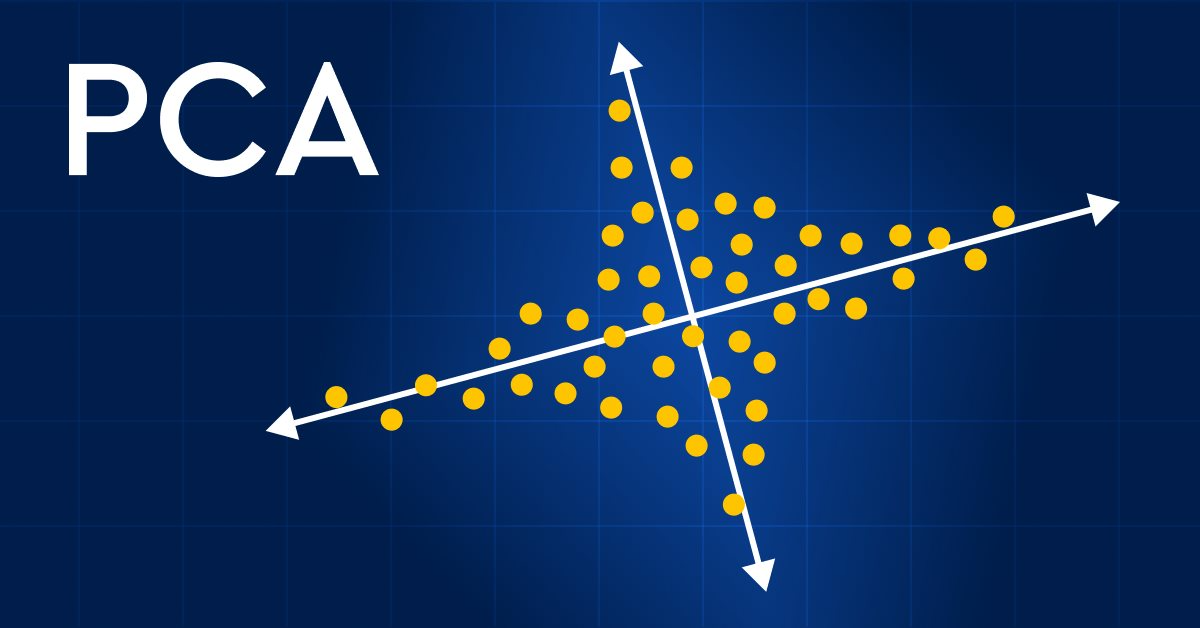

When people think about Machine Learning, they often imagine complex neural networks and massive models. But in practice, some of the most powerful tools come from classical mathematics and statistics. One of them is Principal Component Analysis (PCA).
I use PCA regularly because it sits perfectly at the intersection of:
- Linear algebra
- Statistics
- Practical data science
And it solves very real problems.
What problem does PCA solve?#
In many ML projects, especially in computer vision and data analysis, we work with:
- High-dimensional data
- Noisy features
- Redundant information
PCA helps by:
- Reducing dimensionality
- Removing correlations between features
- Making data easier to visualize and process
- Speeding up downstream models
Mathematically, PCA finds new axes (principal components) that maximize variance. Practically, it gives us simpler and cleaner data.
A simple intuition#
Imagine you have 100 features, but most of the information actually lives in just 10 meaningful directions.
PCA finds those 10 directions.
Instead of learning on 100 dimensions:
You learn on 10 that really matter.
This is both elegant and extremely useful.
How I used PCA in real projects#
In my work on image clustering and classification:
- PCA helped reduce feature size before clustering
- Improved performance of downstream ML models
- Made visualization of image embeddings much clearer
- Reduced noise from irrelevant features
It was a perfect example of how strong mathematical ideas become powerful engineering tools.
Why this matters#
Modern ML is not only about deep learning frameworks.
It is about understanding:
- Your data
- Your features
- Your assumptions
And that is where mathematics quietly does most of the heavy lifting.
Final thoughts#
PCA is simple, old, and beautiful.
And it still competes with much more complex techniques in real-world applications.
That is why I enjoy working in Machine Learning:
It is a field where theory and practice constantly meet.
If you have a strong mathematical background, ML is a natural place to apply it.